Fiber-fast internet brings new energy
to state’s least populated county
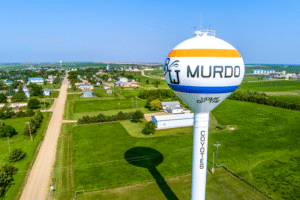 Cristen Roghair had never been west of the Mississippi River until her family moved to Murdo from Chicago when she was a teenager in the mid 1990s. She returned to the Windy City after graduating from Jones County High School, and her family soon moved back, too.
“I was the least likely person to come back,” Cristen says. “I had no ties to come here, but everywhere I lived and worked, there was always a yearning for South Dakota.”
But she did return about five years later. Today she lives east of Okaton with her husband, lifelong Jones County rancher Marty Roghair, and their two children. Cristen feels deeply connected to the open prairie and the agricultural lifestyle, and she documents both through photography.
Tourism and growth go hand in hand
As director of the Murdo Development Corp., Jones County native Ashley Geigle helps current and prospective residents maximize their strengths to meet community needs. She wants to encourage people to spend more time in the area – to get them to go beyond the four-way stop just north of Interstate 90 Exit 192.
“I want people to get excited about remembering when cars would wind down Main Street and keep it thriving,” says Ashley who with her husband, Seth, recently bought a building on Main Street. “Economic development can be a connector to the resources available for businesses.”
Recognized with the Governor’s Tourism Rising Star Award in 2025, Ashley collaborates with many others to tackle issues like housing, daycare, and afterschool programs. Ultimately, she wants Murdo’s population to grow.
To the left of that four-way stop, Vivian Geisler Sonder along with her brother, David M. Geisler, carries on their family’s legacy at the Pioneer Auto Show and Museum. An iconic attraction since 1954, the museum offers a glimpse into the past with vintage oddities and rare antiques.
“This was my playground growing up,” Vivian says. “We grew from 25 cars in one building to six acres with over 250 cars, motorcycles, and the added antique town. We are very thankful for the faster internet from Golden West; it’s such an important service today.”
David also owns the Murdo Super 8 and has served on the city council for nearly 30 years, including the last 14 as mayor. Murdo has a lot going for it, he says.
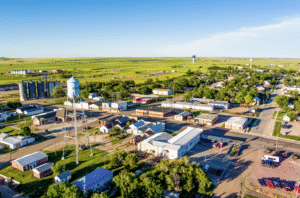
“We have a good school system. We have a really nice nine-hole golf course, a good athletic facility, an Olympic-size pool, walking trail, and tennis courts,” David says. “We’ve got rural water, and we have fiber optic everywhere throughout the town. People can work remotely here and raise their kids.”
Fiber boosts businesses
The Circle E Drive-In sits straight ahead of the four-way stop. Here residents and visitors alike enjoy burgers and other traditional American fare year-round. Chad and Heather Whitney own and operate the restaurant now famous for the Big Al Burger, named in honor of the couple’s son and rated one of the top burgers last year by the South Dakota Beef Industry Council.
“I feel connected with the people in Murdo,” Heather says. “When our son passed away, the support that people had for us is something you can’t find in big cities.”
The family strives to serve food made from scratch. Every burger is made to order, and every sale is made using their Golden West service. Circle E recently added Golden West’s new BizWorks Internet Suite for added reliability and security.
“The security part of BizWorks is awesome,” Heather says about BizWorks. “We know who’s using our internet connection and can better protect our customers’ credit card information. And if we were to lose our connection, we can switch over to using our cell phones to run the point of sale.”
Entrepreneurs powered by fiber
Home-based business owners like Ashley Geigle’s younger sister, Kamaria Labrier, rely heavily on the internet. She runs Prairie Chic Boutique from a custom-built space above her attached garage. She and her husband, Chauncey, ranch seven miles south of Murdo.
Before the fiber-optic upgrade in late 2022, Kamaria made frequent trips to town for an adequate internet connection as her home connection delivered speeds less than 10 Mbps. With her current fiber connection, Kamaria can process orders quickly from home, blending fashion with flexibility.
“I can do all my work in one space because of Golden West,” says Kamaria. “If it’s nap time or the kids are in bed, I can go out and do my work.”
Ashley and Kamaria’s youngest sister, Sophie McKenzie, also operates a business from her rural home about six miles north of Murdo.
Right out of college Sophie taught agriculture classes for Jones County High School and served as the Future Farmers of America adviser. After she and her husband, Murdo-native Craig McKenzie, had their second child, she quit teaching and launched her business, Sugar Coated by Sophie.
Making Murdo home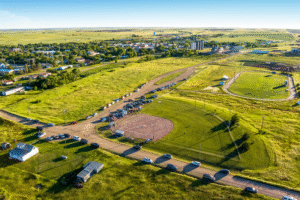
Unlike Cristen Roghair, Sophie always knew she would make Murdo her home.
“I’ve lived in Brookings for college and traveled to Australia, New Zealand, and Canada, but it never really crossed my mind to live anywhere else,” she says. “I enjoyed growing up in Murdo, and I love living here.”
At her history-loving dad’s suggestion and because they liked how it sounded, Sophie and Craig chose the name Murdo for their son. For them, it’s a meaningful reference to the place they grew up, where the town is named after cattle baron Murdo MacKenzie.
Sophie makes and decorates cookies for customers both in her community and the surrounding area, often to be shared at special events. She does it from her family’s ranch using the professional kitchen she and her husband built.
“I do most of my business online,” she says. “I built my website, sell cookies, and run my social media with my Golden West service. People learn about me using the internet, and I use it to grow my business.”
Education and meeting needs
In addition to running her online boutique, helping her husband on the ranch, and raising her kids, Kamaria Labrier also serves on the Jones County School Board. She recognizes the importance of raising and educating the next generation, for her own kids, for her many nieces and nephews, and for all Jones County children.
“There’s nowhere better to raise a family,” Kamaria says. “We’re a close-knit community, and we all take care of each other’s kids. For a small town, there are so many opportunities.”
Teri Kinsley, a longtime second-grade teacher promoted to elementary principal this year, echoes that sentiment.
“Our community is really supportive of the school,” Teri says. “If there’s a basketball game, people will show up and cheer each other on. We really look out for each other.”
In her spare time, Teri runs a screen-printing business from home – a creative outlet that also meets a local need. Like many in Jones County, she wears multiple hats and custom t-shirts, and fiber-based internet helps her juggle them all.
 Contributing to community causes
Jewell Bork works from home for the area’s conservation and development council. She also volunteers with the Jones County Turner Youth Foundation.
The foundation got its start thanks to contributions from CNN founder Ted Turner, who owns land in the northern part of the county. Golden West has also supported the organization along with other youth and general community causes in Jones County and in numerous communities across the service territory.
Youth foundation participants developed a community center in Murdo as a space for events and gatherings of all kinds, including showing movies. Jewell, like many others, supports and gives back to the community, providing a brighter future for the area.
“Internet service from Golden West has opened the door to so many opportunities for me and others,” Jewell says. “The high-speed upgrade was a game changer for the Turner Center to stream the movies we show.”
Creating a sustainable future
Fiber-optic technology plays a crucial role in community sustainability. Cristen and Marty Roghair keep an eye on the future, both through their ranching and Cristen Joy Photography endeavors.
The couple also bridges the past by renovating and transforming the Grandview Township one-room country schoolhouse into the Grandview Gallery. Built in the early 1900s, the school last served students around 1959. Funded with personal money and donations, remodeling has already given the space a new life, with more work planned.
The Grandview Gallery offers space to celebrate not just Cristen’s photos, but all type of art. For example, the gallery hosts periodic music performances which expose area residents and visitors to the prairie and the ranching landscape.
“Murdo is unique because there’s a contrast between two popular parts of South Dakota – tourism and agriculture,” Cristen says. “Here, that blends together and makes up the community I love.”
This article originally appeared in the Golden West 2025 Annual Report which was printed and mailed to members of the cooperative in September 2025.